
Sorry, nothing in cart.
Erectile Dysfunction vs Performance Anxiety
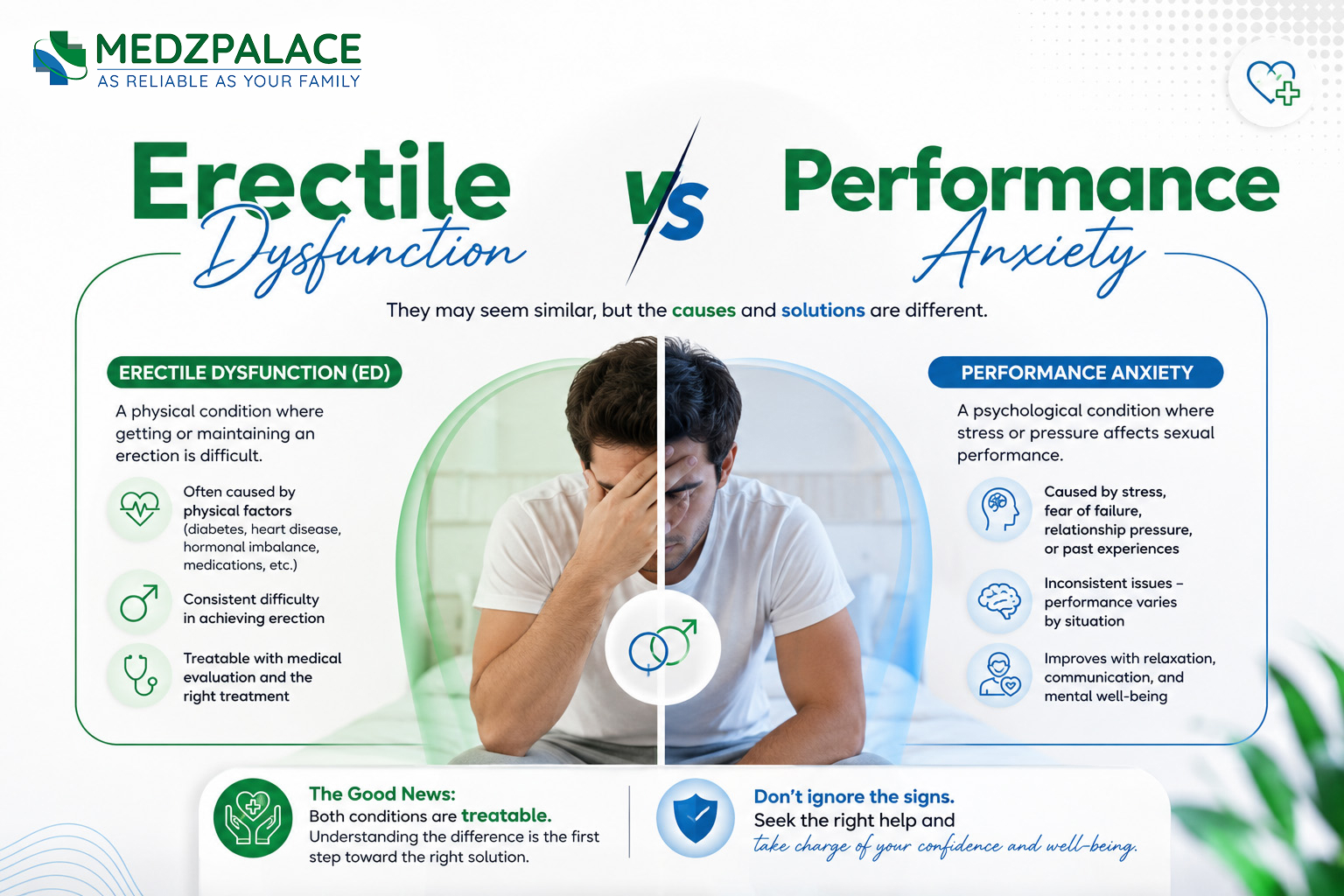
Navigating the complexities of sexual health can be challenging, especially when symptoms overlap and causes are intertwined. This is particularly true for erectile dysfunction (ED) and performance anxiety, two distinct yet deeply connected conditions that affect millions of men. While both can result in the inability to achieve or maintain an erection sufficient for sexual intercourse, their origins, mechanisms, and treatment paths can differ significantly. Understanding the distinction is the crucial first step toward finding an effective solution and reclaiming sexual confidence. This article provides a clinical deep-dive into the pathophysiology of erectile function, the psychology of performance anxiety, and the critical feedback loop that often links them together.
Understanding Erectile Dysfunction (ED)
Erectile dysfunction, clinically known as impotence, is defined as the persistent inability to achieve or sustain an erection firm enough for satisfactory sexual performance. It’s important to note the word “persistent.” Occasional difficulty with erections is common and not necessarily indicative of a clinical diagnosis. ED is considered a medical condition when it becomes a recurring problem, causing distress and impacting a person’s quality of life.
The Physiology of a Healthy Erection
To understand what goes wrong in ED, one must first understand the intricate biological process of a normal erection. It is a complex neurovascular event involving the brain, hormones, nerves, and blood vessels.
- Arousal: The process begins with sensory or mental stimulation. The brain sends nerve signals down the spinal cord to the penis.
- Parasympathetic Response: These nerve signals trigger the release of chemical messengers, most notably nitric oxide (NO), in the erectile tissues of the penis (the corpora cavernosa).
- Vasodilation: Nitric oxide causes the production of cyclic guanosine monophosphate (cGMP), a molecule that relaxes the smooth muscles in the penile arteries. This relaxation allows the arteries to widen (vasodilation), dramatically increasing blood flow into the corpora cavernosa.
- Tumescence and Rigidity: As the erectile tissues fill with blood, they expand and press against the veins that normally drain blood from the penis. This compression traps the blood, leading to the increase in pressure, rigidity, and size known as an erection.
An erection is maintained as long as the arousal signals and the cGMP-mediated vasodilation continue. After ejaculation or the cessation of stimulation, an enzyme called phosphodiesterase type 5 (PDE5) breaks down cGMP, causing the penile arteries to constrict and allowing blood to flow out, returning the penis to a flaccid state.
The Etiology of Erectile Dysfunction: Organic Causes
Organic ED refers to dysfunction caused by underlying physical or physiological problems. These causes can be broadly categorized:
- Vascular Diseases: This is the most common cause of ED. Conditions that affect blood flow throughout the body will inevitably affect blood flow to the penis. These include atherosclerosis (hardening of the arteries), hypertension (high blood pressure), and high cholesterol.
- Neurological Disorders: Since erections rely on nerve signals from the brain, conditions that damage the nervous system can lead to ED. Examples include multiple sclerosis (MS), Parkinson’s disease, spinal cord injuries, and nerve damage from pelvic surgery or diabetes (diabetic neuropathy).
- Hormonal Imbalances: Low testosterone (hypogonadism) can reduce libido and contribute to ED. Other hormonal issues, such as thyroid problems or high prolactin levels, can also play a role.
- Structural or Anatomical Issues: Conditions like Peyronie’s disease, which involves the formation of scar tissue inside the penis, can cause painful erections and physical deformities that lead to ED.
- Medication Side Effects: Many common medications can interfere with erectile function, including certain antidepressants, blood pressure medications (especially diuretics and beta-blockers), antihistamines, and prostate cancer therapies.
Understanding Performance Anxiety
Performance anxiety is a form of anxiety specifically related to sexual performance. It is not a clinical diagnosis in the same vein as ED but is a significant psychological factor that can cause erectile problems. It is a form of psychogenic ED—erectile difficulty originating from psychological, rather than physical, causes.
The Psychology of the Anxious Mind
At its core, performance anxiety is a fear of failure. A man may be overwhelmed by negative thoughts and worries, such as:
- “Will I be able to get an erection?”
- “Will I be able to maintain it?”
- “Will I be able to satisfy my partner?”
- “Am I taking too long?”
- Worrying about premature ejaculation or body image.
These thoughts create a state of “spectatoring,” where the individual is critically observing and judging their own performance rather than being present and engaged in the sexual experience. This mental distraction is profoundly anti-erotic and disruptive to the natural flow of arousal.
The Physiology of “Fight-or-Flight”
The key to understanding how anxiety physically prevents an erection lies in the autonomic nervous system, which has two main branches: the parasympathetic (“rest and digest”) and the sympathetic (“fight or flight”).
Erections are a parasympathetic process. They require a state of relaxation for the blood vessels to open and allow blood to flow in.
Anxiety triggers the sympathetic nervous system. When the brain perceives a threat—in this case, the “threat” of sexual failure—it activates the fight-or-flight response. This floods the body with stress hormones like adrenaline (epinephrine) and noradrenaline.
These stress hormones have a direct and powerful effect on the penis: vasoconstriction. They cause the smooth muscles in the penile arteries to tighten, narrowing the vessels and severely restricting blood flow. This is the body’s way of diverting blood to essential muscles (for fighting or fleeing) and away from non-essential functions like digestion and, crucially, erections. In this state of high alert, achieving an erection is physiologically almost impossible.
The Vicious Cycle: How Performance Anxiety and ED Fuel Each Other
The relationship between ED and performance anxiety is often not a simple case of one or the other. More commonly, they exist in a self-perpetuating psychophysiological feedback loop. This cycle is one of the most challenging aspects of treating psychogenic ED.
- The Initial Incident: The cycle often begins with a single, isolated incident of erectile failure. This could be due to stress, fatigue, alcohol, or a minor physical issue.
- The Anxious Thought: Instead of dismissing the incident, the individual begins to worry about it happening again. The thought “What if I can’t perform next time?” takes root.
- The Next Encounter (Anticipatory Anxiety): Approaching the next sexual situation, the man is no longer relaxed. He is already in a state of anticipatory anxiety, actively monitoring his body for signs of an erection.
- Sympathetic Nervous System Activation: This anxiety triggers the “fight-or-flight” response. Adrenaline is released, constricting the very blood vessels needed for an erection.
- Erectile Failure (Self-Fulfilling Prophecy): The physiological effects of anxiety make an erection difficult or impossible, thus confirming the initial fear. The prophecy is fulfilled.
- Reinforcement and Escalation: This failure reinforces the belief that there is a “problem,” intensifying the anxiety for all future encounters. Each subsequent failure makes the next one more likely, solidifying the pattern and potentially leading to avoidance of sexual intimacy altogether.
This cycle can transform a temporary issue into a chronic problem. It can also occur in men with mild organic ED; the physical difficulty creates anxiety, which then worsens the erectile response beyond what the physical condition alone would cause.
Key Differences: Distinguishing ED from Performance Anxiety
A clinician will look for specific clues in a patient’s history to differentiate between a primarily organic cause and a primarily psychogenic one.
Consistency of Symptoms
- Performance Anxiety: Erectile problems are often situational. The man may have no trouble achieving firm erections during masturbation or upon waking in the morning (nocturnal/morning erections) but struggles specifically during partnered sex. This is a classic sign, as the pressure to perform is absent in these other contexts.
- Organic ED: The difficulty is typically more consistent across all situations. If a vascular or nerve issue is present, it will likely affect erections during masturbation and reduce the frequency or rigidity of morning erections as well.
Onset of the Problem
- Performance Anxiety: The onset is often sudden and can be linked to a specific life event, a new partner, or a stressful period.
- Organic ED: The onset is usually gradual, worsening over months or years as the underlying physical condition (like atherosclerosis) progresses.
Associated Risk Factors
- Performance Anxiety: More common in younger men and those without other medical conditions. May be associated with general anxiety disorder, depression, or significant life stressors.
- Organic ED: More common in older men and strongly associated with risk factors like diabetes, heart disease, obesity, smoking, and hypertension.
Diagnostic Approaches: Identifying the Primary Cause
A thorough evaluation is essential to create an effective treatment plan.
Medical and Sexual History
This is the most critical part of the diagnosis. A doctor will ask detailed questions about the nature of the erectile problems, libido, relationship status, stress levels, medications, and lifestyle habits (smoking, alcohol use). Questionnaires like the International Index of Erectile Function (IIEF) can help quantify the severity of the problem.
Physical Examination
A physical exam helps identify signs of underlying conditions. This includes checking blood pressure, examining the penis and testes, and assessing for signs of vascular, hormonal, or neurological problems.
Laboratory Tests
Blood tests can be ordered to check testosterone levels, blood sugar (for diabetes), cholesterol, and other relevant health markers.
Nocturnal Penile Tumescence (NPT) Testing
In some cases, a doctor may recommend an overnight test to monitor erections during sleep. Healthy men typically have several erections during REM sleep. If a man has normal nocturnal erections but cannot get an erection while awake with a partner, the cause is almost certainly psychogenic.
Treatment Strategies: A Tailored Approach
The right treatment depends on the primary cause, though a combination approach is often most effective.
Treating Primarily Organic ED
- Lifestyle Modifications: The first line of defense includes improving diet, increasing exercise, losing weight, quitting smoking, and reducing alcohol consumption. These changes can significantly improve vascular health.
- Oral Medications (PDE5 Inhibitors): Drugs like sildenafil (Viagra), tadalafil (Cialis), and vardenafil (Levitra) are highly effective. They work by blocking the PDE5 enzyme, allowing cGMP to remain active longer, which enhances the blood flow response to sexual stimulation. Importantly, these drugs do not create arousal; they only facilitate the physical erection mechanism when a man is already sexually stimulated.
- Other Medical Treatments: If oral medications fail, other options include vacuum erection devices, penile injections (alprostadil), or, in severe cases, surgically implanted penile prostheses.
Treating Primarily Performance Anxiety
- Cognitive Behavioral Therapy (CBT): This form of psychotherapy is highly effective for anxiety. A therapist helps the individual identify, challenge, and reframe the negative thought patterns that trigger the anxiety cycle.
- Sensate Focus: A technique used in sex therapy where a couple engages in non-demanding, non-genital touching exercises. The goal is to remove the pressure to achieve an erection and instead focus on physical sensations and intimacy, retraining the brain to associate sex with pleasure instead of anxiety.
- Mindfulness and Relaxation Techniques: Practices like meditation and deep breathing can help train the individual to manage anxiety in the moment, reducing the sympathetic nervous system’s “fight-or-flight” response.
The Combined Approach: Breaking the Cycle
For the many men caught in the vicious cycle, a dual approach is often best. A doctor might prescribe a low dose of a PDE5 inhibitor, not to treat a physical problem, but to provide a “safety net.” Knowing the medication will likely help him achieve an erection can break the cycle of anticipatory anxiety. This success builds confidence, allowing the man to engage in therapy (like CBT or sensate focus) to address the underlying psychological triggers. Over time, as confidence is restored, the reliance on medication can often be reduced or eliminated.
Frequently Asked Questions (FAQs)
Can performance anxiety turn into long-term ED?
Yes. If left unaddressed, the vicious cycle of anxiety and failure can become a deeply ingrained psychological pattern, leading to chronic psychogenic ED and avoidance of intimacy. It can also cause relationship distress, further compounding the problem.
Are strong morning erections a guarantee that my problem is just anxiety?
The presence of consistent, firm nocturnal or morning erections is a very strong indicator that the physical machinery for an erection is working correctly and that the problem is likely psychogenic. While it’s not an absolute guarantee, it is one of the most reliable clinical signs used to differentiate between organic and psychogenic causes.
Can ED medication like sildenafil (Viagra) cure performance anxiety?
No, these medications do not treat the underlying anxiety. They treat the symptom (difficulty with erection) by making the physical process easier. However, by ensuring a successful erection, they can be a powerful tool to break the psychological cycle of failure and fear, thereby boosting confidence. This often provides the mental space needed for a man to overcome the anxiety itself, especially when combined with therapy.
Is it normal to occasionally have trouble with an erection?
Absolutely. Virtually every man will experience occasional difficulty achieving or maintaining an erection at some point in his life. Factors like stress, fatigue, illness, or excessive alcohol can easily interfere with the process. It only becomes a clinical issue when it is a persistent and distressing problem.
Medical Disclaimer: This article is for informational purposes only and does not constitute medical advice. The information contained herein is not intended to be a substitute for professional medical advice, diagnosis, or treatment. Always seek the advice of your physician or other qualified health provider with any questions you may have regarding a medical condition. Do not disregard professional medical advice or delay in seeking it because of something you have read in this article.